Over the summer I have expanded my knowledge of educational assessment and of assessment technologies during my course, CEP 813, Electronic Assessment For Teaching and Learning. I have broadened my perspective of what assessment technology includes (Selwyn, 2011), developed a more critical eye for assessments (Au, 2008) and grading in general (Kohn, 2011), and turned towards developing more equitable, supportive, and culturally relevant assessments (Montegegro & Jankowski, 2017). I experimented with assessment technologies, practiced with different assessment techniques, and played with assessment design prompts.
For my final assessment design in CEP 813, I designed a module for my student employees at the library makerspace. Students will learn a new makerspace technology, develop their ability to teach others, and create high quality media to support others in learning that technology. Using a common makerspace framework of imitate, modify, innovate (Zigler, 2023), students follow a tutorial, then consider how it could be improved or create a new tutorial, and take high quality photos or videos that support the improved tutorial.
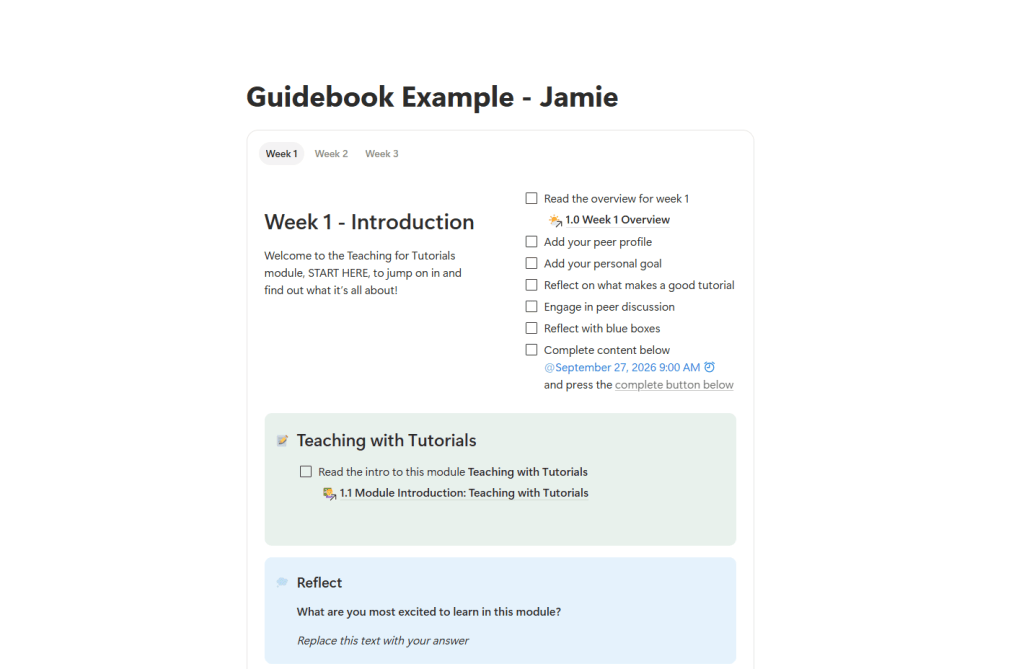
I used three digital technologies in this assessment design: Notion, Lucidspark, and Zulip. Notion is basically the three ring binder holding all the content, worksheets, progress tracking, and due dates together. Zulip provides synchronous communications that are easy to catch up on later, asynchronously. Finally, Lucidspark crams an infinite collaborative whiteboard right inside the three ring binder. The technology trifecta results in a flexible asynchronous or synchronous communication method, digitally, and collaboratively. It allows for a variety of ways to participate in content with images, words, writing, video, or just audio. However, it is always crucial to consider the benefits and risks, and carefully consider the technology’s privacy and data policies – especially when it comes to student data.

In the spirit of well crafted, meaningful, and measurable learning objectives, I would like to take you on a journey of how my final assessment design is intentional, aligned, meaningful, and manageable.
LO1 – Create assessments that intentional
Assessment doesn’t need to be a stress-inducing experience, it can be a supportive guiding process such as the creative sketchbook with integrated reflections and assessments I created just last month. When combining formative assessment with social collaborative learning, assessment supports and cultivates a learning community (Sheppard, 2000). In order to intentionally craft assessments that support learning, they must be designed with the goals and outcomes in mind.
LO2 – Create assessments that are aligned
Using Backward Design (Wiggins & McTighe, 2005), I start with learning objectives or the outcomes the learners need to learn, and how I’ll measure those objectives with assessment. I always find it tempting to jump straight into designing content and activities, but without the target and a yardstick, the path will not align with the goal. I also plan for how to assess the assessment and consider what data I might need for calibrating the alignment.
LO3 – Create assessments that are meaningful
Meaningful assessments are ones that feel like a natural path towards your personal trajectory because they have immediate value in one’s life, align with personal values, and connect the current learning experience to prior understandings. My learning objectives for the assessment include a fill in the blank fifth objective for a personal goal or aspect to develop during the module. By acknowledging the learner’s prior knowledge, personal goals, and supporting their growth, the assessment is a valuable and meaningful tool for learning (Montegegro & Jankowski, 2017). Using Universal Design for Learning (CAST, 2024), the digital collaborative notebook and interactive whiteboard support social collaborative learning in a flexible manner that supports learner agency and provides multiple means of engagement, representation, and expression.
LO4 – Create assessments that are manageable
Manageable assessments are focused on the goals while also supporting learnings through clear goals, scaffolding through tutorials and self-guided content, provide opportunities for social learning, self-assessment, and reflections. The guidebook collects all of these components and combines them into a single digital guidebook for instructor-learner interactions, and social collaborative activities using an infinite whiteboard.
However, in order for an assessment to be manageable it must be easy to access and use, easy to track progress and tasks, and support clear communication – for both the learner and the instructor. The assessment technology guides the learner along a focused path rather than creating distractions or barriers. In this case, Notion supports both learner and instructor by tracking progress, automatic reminders, notifications to the instructor for feedback, ensures instantly collected assessment data, and supports easily giving the learner feedback.

The last component of manageable assessment is the evaluation of the progress, feedback to the learner, and feedback from the learner for improvement of the assessment for future learners. The criteria for success are clearly communicated to the learner and evaluated as fairly and objectively as possible. For this assessment, I created a rubric based on the idea that the students have different experience levels and need appropriately matched goals with a description of what success looks like for each objective. Students receive narrative feedback for each criteria based on their experience level description of success. The feedback is specific, meaningful, and manageable for the instructor to provide and manageable for the student to apply. It includes celebration of the learning progress, and feedback for how to further improve at each formative stage and at the end with a summative assessment.
With intentional, aligned, meaningful, and manageable assessments, learners are empowered on their journey to success, the instructor is empowered with the right data to support the learner, and the assessment itself is calibrated with feedback.
Explore the guidebook yourself in a public view only mode.
References
Au, W. (2008). Unequal by design: High-stakes testing and the standardization of inequality. Routledge.
CAST (2024). Universal Design for Learning Guidelines version 3.0 [graphic organizer]. https://udlguidelines.cast.org/static/udlg3-graphicorganizer-digital-nonumbers-a11y.pdf
Kohn, A. (2011). The case against grades. Alfie Kohn. https://www.alfiekohn.org/article/case-grades/.
Montenegro, E., & Jankowski, N. A. (2017). Equity and assessment: Moving towards culturally responsive assessment. (Occasional Paper No. 29). University of Illinois and Indiana University, National Institute for Learning Outcomes Assessment (NILOA).
Shepard, L. A. (2000). The role of assessment in a learning culture. Educational Researcher, 29 (7), 4-14.
Wiggins, G., & McTighe, J. (2005). Understanding by design, (2nd Ed.). Association for Supervision and Curriculum Development.
Zigler, M. (2023). 3 modes of making: Imitation, modification, innovation (First edition.). Make Community, LLC.


